CYBER RANGES Injector Engine Latest Version Overview

The latest version of CYBER RANGES Injector Engine introduces enhancements that further elevate its realism and flexibility, distinguishing it from prior iterations. Most notably, as also beta-presented at U.S. Army Future Command’s Cyber Quest 2024, the newest release (Injector Engine 3.0) emphasizes state-of-the-art advanced attack emulation capabilities.
CYBER RANGES Injector Engine Latest Version Overview

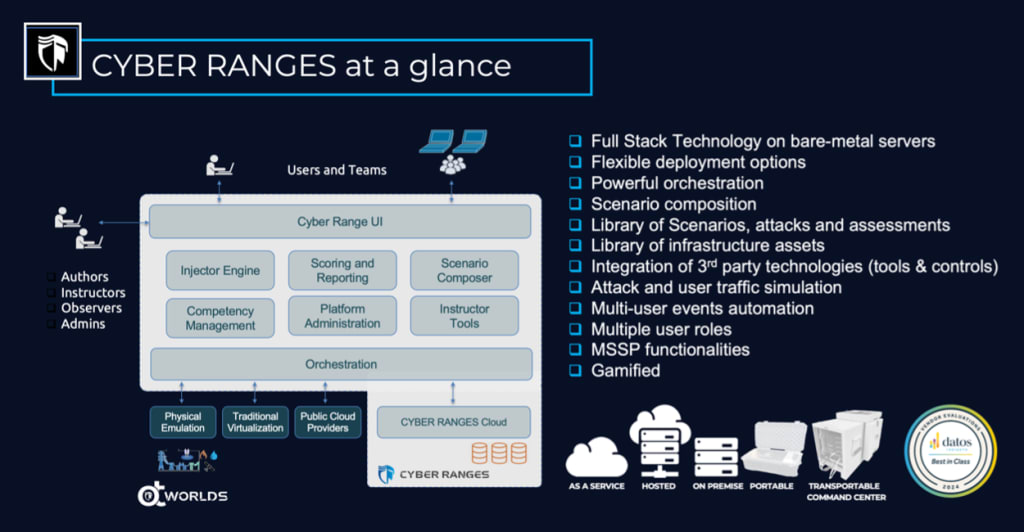
The CYBER RANGES Injector Engine is the core component of the CYBER RANGES platform responsible for orchestrating realistic cyber exercises.

It automates a wide range of activities in a cyber range scenario – from simulating benign user behavior to injecting malicious cyber-attacks – in order to create life-like training and testing environments.

In a typical cyber drill (whether for training or capability/readiness validation), the Injector Engine generates background network traffic, user actions, and multi-stage attack campaigns, all within an isolated virtual infrastructure that mirrors an organization’s real networks and systems, both cyber and physical.

The latest iteration of CYBER RANGES Injector Engine builds upon previous versions by increasing the fidelity of these simulations and deepening integration with threat intelligence sources, thereby delivering more authentic attack patterns and user workflows than ever before.

Simulating Real User Activity

One of the Injector Engine’s key capabilities is the realistic simulation of user activity and network traffic. It can inject diverse background traffic to mimic everyday business operations – for example, simulating users browsing websites, streaming video, engaging on social media, or performing peer-to-peer file sharing. These background behaviors generate normal traffic patterns (HTTP, DNS, email, etc.) and event logs at scale, creating a “noise floor” against which security teams must distinguish malicious events.

Crucially, Injector Engine supports stateful traffic generation, meaning it does not just replay static packets – it can establish dynamic connections and sessions between virtual systems to emulate services like web servers, DNS queries, or even Tor exit nodes and command-and-control servers. This ensures that defenders experience realistic network conditions with thousands of baseline events and legitimate user actions happening in parallel, forcing them to find the proverbial needle in the haystack when an attack is hidden among normal activity

By reproducing human-like behavior and business traffic at scale, CYBER RANGES Injector Engine provides high-fidelity user simulation that tests security monitoring under real-world conditions (e.g., can the SOC spot an anomaly when the network is busy with day-to-day operations?).

Emulating Real-World Cyberattacks

In parallel with benign traffic, the Injector Engine can emulate sophisticated cyber-attacks end-to-end.

It allows scenario designers to configure and automate sequences of malicious actions – from simple scans or exploits up to full Advanced Persistent Threat (APT) campaigns.

Attacks are composed of modular, atomic “injections” which can be chained into complex attack flows with conditional logic and scheduling.

Each injection can either replay captured malicious traffic (e.g. replaying a PCAP file of a malware infection) or execute real attack tools/commands in the range environment.

Notably, user-defined injections allow Injector Engine to run actual malware samples or exploit code (safely contained in the virtual sandbox environment) to simulate a real attacker’s actions. This stateful approach – effectively running the same steps an adversary would – means the emulation fidelity is very high.

For example, one can emulate a ransomware attack by detonating the ransomware in a victim’s VM, or emulate a nation-state intrusion by performing the same reconnaissance, exploitation, and lateral movement techniques that a known APT group would use.

CYBER RANGES Injector Engine comes with an extensive attack library of pre-built attacks and threat sequences, covering common malware and attacker techniques as well as full attack scenarios mapped to the MITRE ATT&CK® framework.

Using this library, an operator can easily deploy anything from a basic SQL injection or phishing email, to a multi-stage attack chain that exploits human and technical vulnerabilities in tandem.

During live exercises, the White Team (exercise controllers) can even trigger on-the-fly injections using the engine – for instance, launching a new surprise attack in the middle of a scenario – to test how participants adapt under pressure.

Overall, CYBER RANGES Injector Engine’s attack emulation capability provides true-to-life offensive scenarios where defenders face authentic tactics and malware, not simplistic test scripts.

Threat Intelligence-Powered Features

A distinguishing strength of CYBER RANGES Injector Engine is that it is powered by up-to-date threat intelligence.

The platform fully aligns its scenarios and attack content with the latest adversary tactics, techniques, and procedures as documented by industry frameworks like MITRE ATT&CK®.

In practice, this means CYBER RANGES Injector Engine’s attack library and injections are continually informed by real-world cyber threat data – new malware behaviors, recent APT campaigns, emerging threat actor TTPs, etc.

For example, if threat intel reports reveal a new data exfiltration technique or a novel privilege escalation exploit being used in the wild, Injector Engine can incorporate those into its scenarios to keep training exercises current.

CYBER RANGES Injector Engine provides MITRE ATT&CK–based injections, essentially turning the ATT&CK knowledge base into live test cases. This gives organizations an accessible library of adversary behaviors and the ability to “detonate” those tactics safely in a sandbox environment.

Security teams can thereby rehearse detecting and responding to the kinds of attacks that are actually hitting their industry peers. The tight integration of threat intelligence ensures realism and relevance – the simulated attacks are not generic or outdated, but mirror the latest-intelligence threats adversaries are using.

This threat-informed approach is a key factor that sets CYBER RANGES apart: it enables threat hunting and defensive validation against known APT groups or malware families in a controlled setting.

In essence, the Injector Engine operationalizes cyber threat intelligence by taking indicators and TTPs from reports and emulating them in scenarios – giving defenders practical experience with cutting-edge threats before those threats hit their live networks.

This approach has underpinned the development of the recently mil-grade TRYZUB-Trident scenarios made by Ukraine’s national CERT (within SSSCIP) on their cyberwar intelligence and powered by CYBER RANGES.

What’s New in the Latest Version

The latest version of CYBER RANGES Injector Engine introduces enhancements that further elevate its realism and flexibility, distinguishing it from prior iterations. Most notably, as also beta-presented at U.S. Army Future Command’s Cyber Quest 2024, the newest release (Injector Engine 3.0) emphasizes state-of-the-art advanced attack emulation capabilities.

This means it can replicate even more complex attack scenarios with greater fidelity, informed by the most recent threat research.
Compared to earlier versions, which already offered robust traffic simulation and a catalog of ATT&CK techniques, CYBER RANGES Injector Engine version 3.0 expands on automation and orchestration. For example, it provides more advanced logic for conditional and adaptive attacks – enabling scenario scripts to alter their behavior based on defender actions or injected telemetry (mimicking an adversary that reacts to what the defenders do). It also boasts a broadened library of threats, including the latest cyber threat intelligence-based attacks and advanced persistent threats observed in the wild.

In collaboration with the US MITRE Corporation’s MITRE Engenuity, CYBER RANGES has incorporated feedback from the ATT&CK Defender™ program and purple teaming exercises to refine the Injector Engine’s content and usability. The new version also improves performance and scale – it can generate larger volumes of background traffic and concurrent attack threads, supporting bigger and more complex scenarios than before. In practical terms, these upgrades mean that exercises run on Injector Engine 3.0 feel even closer to reality: the user behaviors are more varied, the threat emulations cover the newest attacker tradecraft, and the system can seamlessly execute full-spectrum cyber campaigns for training or technology validation.

CYBER RANGES demonstrated these next-gen capabilities at the U.S. Army’s Cyber Quest 2024 event, where Injector Engine 3.0 was used to power cutting-edge cyber attack emulations as part of a military technology assessment.

In summary, the latest version builds on a proven foundation of cyber range automation by layering in greater threat fidelity, intelligence-driven updates, and adaptive attack logic, ensuring that organizations can continuously test themselves against the modern evolving threat landscape – something earlier versions could only approximate to a lesser degree.

Emulation vs. Simulation in Cybersecurity Technology Validation

When evaluating cybersecurity technologies (such as, e.g., intrusion detection systems, endpoint defenses, or SOC procedures), two common test approaches are adversary emulation and threat simulation. While these terms are sometimes used interchangeably, they represent distinct strategies with different methodologies, fidelity levels, outcomes, and ideal use cases.

Understanding their differences is crucial when designing a validation or training exercise, as each approach offers unique insights into an organization’s security posture.

Methodology and Approach

Adversary Emulation involves replicating the specific Tactics, Techniques, and Procedures (TTPs) of real threat actors as faithfully as possible. It is a focused, intelligence-driven approach: the testing team researches a particular adversary (for example, a nation-state APT group or a known ransomware gang) and then mimics that adversary’s modus operandi step by step in a controlled environment. The goal is to “play the role” of that attacker, using the same tools, exploits, and techniques they have used in actual incidents, so that the defense can be evaluated against a highly realistic threat scenario.

Emulation relies heavily on detailed threat intelligence – it requires knowing how an attacker operates (their malware, C2 infrastructure, kill chain, etc.) and re-creating those conditions.
Essentially, adversary emulation asks “If a specific known attacker targeted us, could they succeed?” and tries to answer by staging an attack identical to what that attacker would do. This may involve using live malware (or close variants), real phishing lures, and penetration methods in a test network that closely mirrors production.

Adversary Simulation, on the other hand, takes a broader and more flexible approach. Rather than copying one particular threat actor, simulation models a range of potential attacker behaviors in order to test defenses more generally (What is Adversary Emulation? | Picus). It is less constrained by a single threat profile – the testers might combine techniques from multiple sources or generate hypothetical attack sequences that could happen, even if no specific actor has employed them exactly that way.

The emphasis is on breadth and coverage of attack vectors rather than one-to-one fidelity to a known adversary.
For example, a simulation might include generic brute-force login attempts, privilege abuse scenarios, data exfiltration trials, etc., drawn from common attack patterns. Simulation often uses automation tools (sometimes called Breach and Attack Simulation tools) that have libraries of various techniques to execute in the environment.

These tools do not strictly adhere to any single threat actor’s playbook (What is Adversary Emulation? | Picus); instead, they ensure that a wide array of tactics are tried, to see what might slip past defenses.
In summary, simulation asks “What would happen if any attacker used these tactics against us?”, focusing on versatility and coverage over exact real-world fidelity.

Methodology and Approach

Because of these methodological differences, fidelity – the realism or faithfulness of the test – also differs between emulation and simulation.

Emulation tends to offer higher fidelity: it seeks to exactly replicate real attack processes and malware, thereby producing effects and signals virtually identical to an actual breach by that adversary.

In an ideal adversary emulation, the only difference from a real attack is that it’s done in a controlled setting – otherwise, the tools, sequence, and even the network traffic or malware binaries might be the same as a genuine incident. This means emulation can provide very accurate insight into how a security technology (or team) would perform against the real threat. However, achieving this fidelity requires significant effort and careful isolation (you wouldn’t unleash a live adversary toolkit in a production network without containment!). Simulation offers a broader but sometimes lower-fidelity test.

By modeling the general behavior of attacks through software abstractions, simulations might simplify or omit certain details of real exploits. For instance, a simulation might imitate the “behavior” of ransomware (encrypting files) with a benign script rather than deploying actual ransomware malware, to avoid risk. The focus is on generating representative inputs and outputs – e.g., producing log events that look like those from an attack – rather than perfectly cloning the attack’s internals. According to one definition, simulation is “the act of modeling…the general behavior of a system…starting from a conceptual model” (Cybersecurity risk reduction leveraging cyber range solutions).

In practice, this means simulations are usually safer and easier to repeat, but may not exercise every low-level detail of an attack. Emulation, by contrast, is “the act of replicating…in a different system, exactly how the original system works internally” (Cybersecurity risk reduction leveraging cyber range solutions). This implies that emulating an attack tries to reproduce the actual exploit code’s effect on a system (internal behavior), whereas simulating the attack might only reproduce the observable symptoms.

The trade-off here is that while emulation provides higher realism (and thus can uncover subtle issues a simulation might miss), simulation can be conducted with lower risk and often with less specialized knowledge (since you don’t need the exact malware, just something that behaves similarly from a defender’s viewpoint).

Outcomes and Insights

Because emulation and simulation differ in fidelity and focus, the outcomes and insights gained from each can vary.

Adversary emulation yields very threat-specific results. It will definitively show how the target environment holds up against that particular threat actor or attack scenario. This is valuable for organizations worried about certain adversaries – for example, a bank can directly assess its controls against a known banking Trojan operation. Emulation can highlight any gaps in defenses against the TTPs of that specific actor (e.g., perhaps the firewall fails to spot the C2 beacon, or the EDR misses a privilege escalation exploit) and thereby guide improvements tightly aligned to real threats. However, emulation is narrow in scope: it answers “could Threat X compromise us?” but doesn’t necessarily explore attacks outside of Threat X’s repertoire.

Adversary simulation provides broader coverage, so its outcomes are more general. A simulation exercise might test dozens of tactics across the kill chain (reconnaissance, intrusion, lateral movement, data theft, etc.) drawn from many threat scenarios. The insight gained is a holistic view of security posture – which attack techniques (in general) are we resilient against, and which tend to succeed? For example, a breach-and-attack simulation (BAS) might reveal that the organization consistently detects network scans and blocked known malware, but repeatedly failed to catch data exfiltration over an unusual port.

This kind of result is not tied to one named adversary but is immensely useful for identifying systemic weaknesses. On the flip side, because simulation uses known or expected attack methods (often based on past incident trends), it might miss novel attack variants or nuanced techniques that a specific hacker group uses. In other words, simulation is excellent for benchmarking and broad validation (it can even produce scores or metrics for different categories of attacks), but it may not provide the crystal-clear realism of a targeted emulation.

It’s also worth noting that simulation outcomes can be limited to known patterns. By design, simulations often replay what has happened before (historical tactics) to see if the organization is prepared for them (Adversary Emulation vs Simulation | Redpoint Cyber). This means they might not reveal unknown vulnerabilities – if an attack method has never been seen and thus not included in the simulation library, the simulation won’t test for it (Adversary Emulation vs Simulation | Redpoint Cyber).

Emulations attempt to bridge that gap by leveraging threat intelligence to include the latest threats (and in some cases, to think like an attacker and try creative approaches), thus they can sometimes expose security gaps that weren’t previously considered.

For example, an emulation might intentionally vary a known attack to see if a slight tweak bypasses defenses, thereby discovering a new blind spot. In essence, emulation asks “what could happen?” not just “what did happen?” (Adversary Emulation vs Simulation | Redpoint Cyber), so it often uncovers potential attack paths that have not yet been observed in the wild but are plausible. This makes emulation a forward-looking approach, revealing how attackers might adapt next.

Appropriate Use Cases and Scenarios

Both adversary emulation and simulation have important roles in cybersecurity technology validation, but they shine in different contexts. Below are typical scenarios where each approach is most effective:

CYBER RANGES-Shield-Icon 21x21 Adversary Emulation – Targeted, High-Fidelity Testing:

This is best applied when an organization wants to assess its defenses against a specific threat or during advanced red team/purple team exercises. For instance, a company in the energy sector might emulate a known APT group that targets industrial control systems, in order to validate that their new intrusion detection system can catch the tactics that group uses.

Emulation is also common in threat hunting and intel-driven assessments: after consuming an intelligence report about a new attack campaign, a security team may use emulation to replicate that attack in a lab and see if their tools detect it, thereby validating (or improving) their alerting rules. In summary, use emulation when fidelity is paramount – e.g. “Can we survive a Cloud Hopper APT attack exactly like those that hit our peers?” – or when testing requires the element of realism to train teams (such as running full attack scenarios in exercises so defenders get experience very close to a real incident).

CYBER RANGES-Shield-Icon 21x21 Threat Simulation – Broad Validation and Continuous Assessment: 

Simulation is ideal for ongoing, automated testing of security controls across a wide range of threats. Many organizations use breach-and-attack simulation platforms to continuously run scripted attacks and benign traffic in their production or staging environments, in order to measure detection rates and identify regressions.

For example, a SOC might schedule daily simulations of different attack techniques (phishing, malware drop, lateral movement attempts) to ensure their SIEM and EDR alerts fire as expected. This approach is great for coverage analysis and compliance: it can demonstrate that critical attack vectors (as listed in a framework or required by an audit) are being tested and that defenses work against them.

Simulation is also well-suited for training at scale and tabletop exercises. In cyber exercises or drills with many participants, simulation can provide the varied background events and a stream of diverse attack attempts needed to exercise the team’s processes (CyberExercises_Resilience,Enhanced_CYBER_RANGES_OnlineVersion).

Essentially, use simulation when the goal is to cast a wide net – “Let’s test everything from malware infections to data leaks in a safe, repeatable way” – or to continuously validate the efficacy of security tools in a non-disruptive manner.

In practice, mature cybersecurity programs often employ both methods in complement. Simulation can run regularly to guard against regression and ensure baseline readiness across common threat scenarios, whereas emulation can be used periodically for deep-dives into high-risk threat actors or novel attack techniques that demand special attention.

By combining the broad coverage of simulation with the granular realism of emulation, organizations can achieve a comprehensive understanding of their security posture. 

In a formal validation report, noting the differences between these approaches underscores why both are valuable: simulation provides breadth and consistency (great for scoring and benchmarking), while emulation provides depth and realism (great for true-to-life assurance and uncovering hidden weaknesses).

Choosing the right approach depends on the validation objectives – whether you need a wide-ranging safety net or a precise threat-informed stress test – and often the answer is a judicious mix of the two.
Mapping-CYBER-RANGES-to-Gartners-Product-Performance-framework with border

Predictive analysis

Gartner Definition

The ability to anticipate and prevent future cyberattacks using threat intelligence, behavioral analytics, and AI-driven cybersecurity knowledge graphs.

CYBER RANGES Capabilities

CYBER RANGES-Shield-Icon 21x21 CTI-Driven Scenarios: CYBER RANGES integrates Cyber Threat Intelligence (CTI), allowing organizations to simulate threat actor behaviors and prepare for realistic attacks.

CYBER RANGES-Shield-Icon 21x21 Threat Actor Emulation: Advanced simulations of cyber threats mapped to MITRE ATT&CK to anticipate potential attack vectors.

CYBER RANGES-Shield-Icon 21x21 Cybersecurity AI Assistants: Features such as adaptive learning and automated detection to model and analyze threats proactively.

CYBER RANGES-Shield-Icon 21x21 Scenario Foundry: The ability to build AI-powered predictive threat models and generate adversarial playbooks.

Automated exposure management

Gartner Definition

AI-driven automation for vulnerability assessment, exposure discovery, and remediation processes.

CYBER RANGES Capabilities

CYBER RANGES-Shield-Icon 21x21 Live-Fire Cyber Exercises: Used to evaluate and improve vulnerability detection through red-teaming and attack emulations.

CYBER RANGES-Shield-Icon 21x21 Scenario Composer & Injector Engine: Automates exposure discovery and security response testing by injecting realistic attack traffic and behaviors.

CYBER RANGES-Shield-Icon 21x21OT Worlds & ICS Simulations: Integration with Operational Technology (OT) and Industrial Control Systems (ICS) to simulate cyber-physical vulnerabilities.

CYBER RANGES-Shield-Icon 21x21 Cyber Resilience Assessment: Uses incident response scoring and automated penetration testing workflows to map out organizational weaknesses.

Preemptive mitigation

Gartner Definition

Proactive defense measures including deception technologies, adaptive security playbooks, and moving target defense.

CYBER RANGES Capabilities

CYBER RANGES-Shield-Icon 21x21 Advanced Cyber Deception: Includes fake networks, honeypots, and misdirection techniques to assess attacker behaviors. It also integrates with the most advanced Deception platforms providers in the market.

CYBER RANGES-Shield-Icon 21x21 Adaptive Playbook Generation: Customizable defensive scenarios based on AI-driven cyber simulations and live attack telemetry.

CYBER RANGES-Shield-Icon 21x21 Tabletop (TTX) and Cross-Cyberdrills (C2 Drills): A structured approach to preemptive cyber defense training, combining operational and strategic exercises.

CYBER RANGES-Shield-Icon 21x21 Scenario Automation & Multi-User Exercises: Designed for nation-state
defense, large-scale simulations for government, military, and corporate
teams.

Cybersecurity training & workforce development

Gartner Definition

Cyber ranges should be scalable and multi-tenant to support enterprise, government, and military training initiatives.

CYBER RANGES Capabilities

CYBER RANGES-Shield-Icon 21x21 Multi-Tenant Cyber Range: Designed for large-scale workforce training with private, on-premises, hybrid and full cloud deployments.

CYBER RANGES-Shield-Icon 21x21 MITRE ATT&CK-based Training: Official cyber range for MITRE ATT&CK Defender™ (MAD™) training and Purple Team exercises.

CYBER RANGES-Shield-Icon 21x21 AI-based Training & Performance Scoring: Uses real-world threat emulation, attack assessments, and dynamic learning paths.

CYBER RANGES-Shield-Icon 21x21 Leading Cyber Drills: Used by global and national government and military organizations across multiple geographies, for large-scale, multi-stakeholder cyber exercises.

Why CYBER RANGES is the Preferred Choice for organizations worldwide?

Unlike some vendors that offer limited customization options, require cloud-only access, or provide less advanced attack emulation features, CYBER RANGES delivers a more adaptable and comprehensive solution.

CYBER RANGES offers:

✔ Multi-tenant, high-fidelity simulation environments
✔ Full integration of ICS/OT networks with HIL capabilities
✔ CTI-driven attack scenarios mapped to real-world threats
✔ Cloud, on-premises, and portable deployment models
✔ End-to-end cyber resilience training with automated assessment tools
✔ Military-grade security, incorporating advanced encryption protocols, secure network segmentation, compliance with NIST and ISO security standards, and hardened environments for governments, enterprises, and critical infrastructure sectors.

Experience CYBER RANGES

In an era where preemptive cybersecurity is paramount, CYBER RANGES leads the way by offering the most comprehensive, scalable, and engaging cyber range training available.

Request a demo today and see how CYBER RANGES can enhance your cybersecurity workforce, reduce risk exposure, and prepare your organization for the future of cyber warfare.

For media enquiries: Marcello Hinxman-Allegri, Head of Marketing & Business Development

For industry enquiries: Michael Roncon, Head of Defense & National Security

CYBER RANGES Corp. – Quantico Cyber Range, Suite 305, 1010 Corporate Drive, Stafford, VA 22554

E-mail: contact@cyberranges.com | Web: www.cyberranges.com | Freephone: 1-800-959-0163

Learn More About Cyberdrills

CYBER RANGES has developed a strong global reputation for providing national, International, industry specific and bespoke high-fidelity Cyberdrills for multiple vertical sectors.

Free Community Scenarios

The CYBER RANGES Community is a free collaborative space for learners and professionals looking to upskill their cybersecurity prowess, start your CYBER RANGES journey here.

X
LinkedIn
Facebook
Reddit
Telegram
WhatsApp
Email
Scroll to Top